
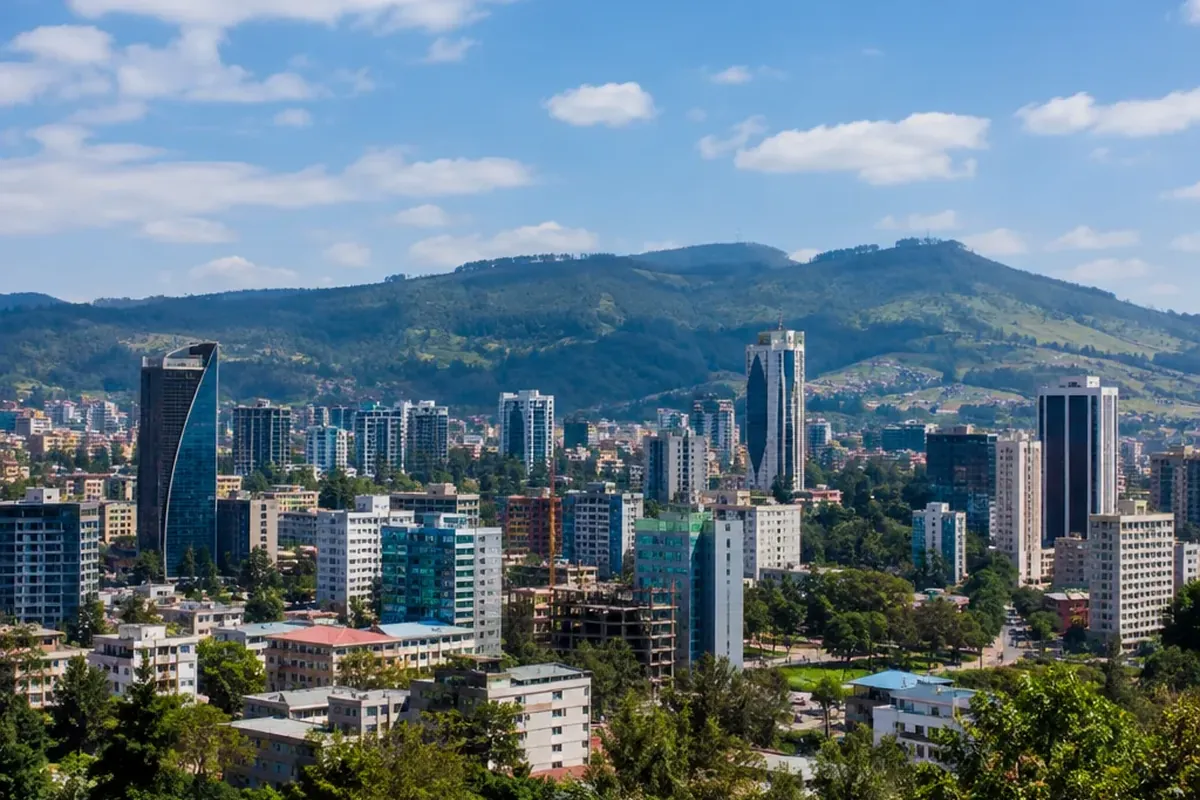
Addis Ababa is the capital of Ethiopia, a highland city where the country’s national story meets continental diplomacy. At 2,355 meters (7,726 feet) above sea level, it combines an imperial-era origin, major Ethiopian Orthodox landmarks, Africa’s largest concentration of diplomatic missions, and a museum encounter with Lucy, a 3.2-million-year-old hominid fossil.
How Addis Ababa became the capital of Ethiopia
In 1886 or 1887, Emperor Menelik II and Empress Taytu Betul founded Addis Ababa, replacing Entoto as the capital. Because of extreme cold and an acute shortage of firewood, Entoto had become difficult to sustain. At the foot of the Entoto tableland, Taytu was drawn to the hot springs of Felwuha, or Filwoha, and built her home there; that choice marked the beginning of the city.
Chosen by Empress Taytu, the name Addis Ababa means “New Flower” in Amharic. In its earliest years, the settlement was closer to a military encampment centered on the emperor’s palace than to a conventional town. To address the fuel-wood crisis, large numbers of eucalyptus trees were imported from Australia in 1905. Across the city, the trees spread and provided forest cover, earning Addis Ababa the nickname “Eucalyptopolis.”
Another formative chapter came with Italian occupation. From 1936 to 1941, Addis Ababa served as the capital of Italian East Africa. During that period, modern stone houses, paved roads, a water reservoir at Gefarsa, and a hydroelectric station at Akaki were introduced.
Where Ethiopia’s capital sits—and why its altitude matters
On a well-watered plateau in the Ethiopian Highlands, Addis Ababa lies at the western edge of the Great Rift Valley. At 9°2′9″N, 38°45′9″E, the city proper covers 526.99 square kilometers. To the immediate north, the Entoto hills rise above 3,000 meters amid the surrounding hills and mountains.
At 2,355 meters, Addis Ababa is the fourth-highest capital city in the world and the highest capital in Africa. Through the year, that height helps explain the city’s mild temperatures, but it also makes altitude an essential part of the experience. Near Ethiopia’s geographic center, the city is about 561 kilometers from Djibouti, the nearest national capital. In Addis Ababa, local time is East Africa Time, UTC+3.
Why Addis Ababa is Africa’s diplomatic hub
Because continental and international institutions are concentrated here, Addis Ababa is often called the political capital of Africa. In the city, the African Union has its headquarters; its predecessor, the Organisation of African Unity, was founded here in 1963. With more than 120 foreign embassies and diplomatic missions, Addis Ababa has the largest such concentration on the continent.
At Africa Hall, inaugurated in 1961, the city also hosts the United Nations Economic Commission for Africa. Founded in 1958, UNECA opened its first session in Addis Ababa on December 29 of that year, inaugurated by Emperor Haile Selassie.
One visible symbol is the African Union Conference Center and Office Complex. Built from 2009 to 2012, the complex cost US$200 million and was mainly funded by the Chinese government. At 99.9 meters (328 feet), its main building rises above the campus. Beyond Ethiopia’s administrative center, the site illustrates Addis Ababa’s continental importance.
A capital city measured in people, districts, and connections
Population figures vary with the boundary being measured. In a 2026 estimate, the Addis Ababa metro area reaches 6.219 million people, while a density-based urban-area definition counted about 6.7 million residents in 2025. About 5% of Ethiopia’s national population lives in the capital. For comparison, the 2007 census counted 2,739,551 people in the city proper, living in 662,728 households with an average of 5.3 people per household.
Administratively, the city is divided into 11 sub-cities, with Lemi-Kura added in 2020. Its religious affiliation includes 43% Ethiopian Orthodox, 33% Muslim, 20% Protestant, and 0.48% Catholic. At Bole International Airport, Ethiopian Airlines operates its hub, serving 116 international and 23 domestic destinations.
| Measure | What it shows |
|---|---|
| Elevation | 2,355 meters (7,726 feet) above sea level |
| City proper area | 526.99 square kilometers |
| Metro estimate | 6.219 million people in 2026 |
| Sub-cities | 11 |
What to see for a grounded first visit
For travelers interested in Ethiopian history, living religious traditions, and the institutions that connect Africa, Addis Ababa is worth visiting. Near Addis Ababa University on King George VI Street, the National Museum of Ethiopia was established in 1958. Its best-known exhibit is Lucy, or Dinkinesh in Amharic (“you are marvellous”), an Australopithecus afarensis fossil dated to 3.2 million years ago. In the museum’s Paleoanthropology Laboratories, the original fossil is secured; a cast is displayed publicly. In the basement gallery, visitors also find Selam, a fossil dated to about 3.3 million years ago.
- Holy Trinity Cathedral: the highest-ranking Ethiopian Orthodox Tewahedo cathedral in Addis Ababa, inaugurated in 1944 after construction was interrupted by the Italian invasion. Emperor Haile Selassie and Empress Menen Asfaw are buried in its north transept.
- Merkato: Africa’s largest open-air market, in Addis Ketema. Its “terras” organize trade in goods from coffee and spices to textiles, furniture, and scrap-metal recycling.
- The Ethnological Museum: in the former Jubilee Palace of Emperor Haile Selassie on the university campus, with material culture from more than 80 Ethiopian ethnic groups.
- Entoto: north of the city, with views from above 3,000 meters, Entoto Maryam Church, and hiking trails in Entoto Natural Park.
- Light rail: sub-Saharan Africa’s first modern light rail system opened in 2015. Its Blue Line runs 16.9 kilometers with 23 stations, while the Green Line runs 17.4 kilometers.
For a more difficult historical perspective, visit the Red Terror Martyrs’ Memorial Museum near Meskel Square, which documents political violence under the Derg regime from 1974 to 1987.
Choose dry months for clearer days and cold nights
Because of its altitude, Addis Ababa has a subtropical highland climate with mild temperatures year-round. From October through February, the dry season is generally the best time to visit: days are sunny and clear, with temperatures of roughly 10–24°C, while nights can be cold. By average high, March is the warmest month at 23.5°C; December has the lowest average low at 7.56°C.
From June to September, the main rainy season, known as kiremt, arrives; July is the wettest month, averaging 232.92 millimeters of rain. From March to May, smaller belg rains often come as afternoon showers. For public celebrations, travelers can note Timkat on January 19, Genna on January 7, Enkutatash on September 11, and Meskel on September 27.
Common misconceptions about Addis Ababa
“It is simply a modern planned city”
Despite modern infrastructure, including paved roads developed during the Italian occupation and a light rail system opened in 2015, the city’s origins were intensely practical and local: a palace-centered encampment, hot springs, and a search for firewood.
“Its diplomatic role is only ceremonial”
Through the African Union, UNECA, and more than 120 foreign embassies and diplomatic missions, Addis Ababa has a sustained institutional role in African affairs.
“Highland location means uniformly warm weather”
At 2,355 meters, the elevation brings mild daytime conditions, but dry-season nights can be cold. Between a sunny day and an evening, the temperature difference is part of the city’s climate.
“The Ethiopian birr is Addis Ababa’s currency”
Across Ethiopia, the Ethiopian birr is the currency, not a city-only currency. With ISO code ETB and symbol Br, it is divided into 100 satims.
Frequently Asked Questions
What is Ethiopia’s biggest city?
Addis Ababa is Ethiopia’s capital, with a metro area population estimated at 6.219 million people in 2026 and about 6.7 million residents under the UN urban-area definition in 2025, accounting for about 5% of the national population.
What is the capital of Ethiopia, and what is its currency?
As Ethiopia’s capital, Addis Ababa is paired with a national currency: the Ethiopian birr (ETB), symbol Br, divided into 100 satims.
Where is Addis Ababa located, and how high is it?
In the Ethiopian Highlands, on the western edge of the Great Rift Valley, the city stands at 2,355 meters (7,726 feet) above sea level.
What was Ethiopia called in Jesus’ time?
In the first century AD, the Kingdom of Aksum, also spelled Axum, dominated the region of modern-day Ethiopia. Across African, Mediterranean, and Asian networks, Aksum was a major trading empire.
Is Addis Ababa worth visiting?
For a concentrated encounter with Ethiopian history and culture, start with Lucy at the National Museum, Holy Trinity Cathedral, Merkato, Entoto, and sites connected to the African Union.
When is the best time to visit Addis Ababa?
For clearer skies and sunny days, choose the October-through-February dry-season window. Alongside mild-day clothing, pack for colder nights.