
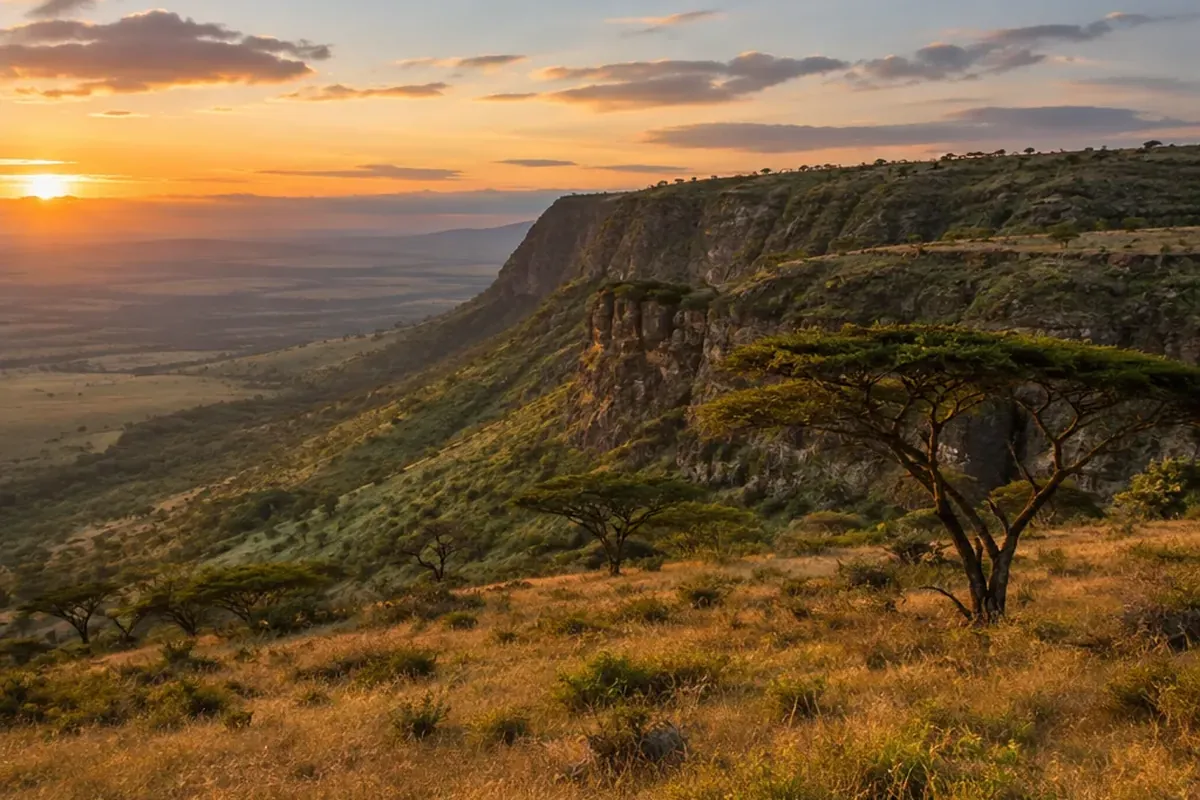
There are 18 East African countries under the United Nations definition. They stretch from Sudan and Eritrea on the Red Sea down to Mozambique, and out to the island nations of the Indian Ocean. In narrower English usage, though, “East Africa” means Kenya, Tanzania, and Uganda. The region holds Africa’s highest peak, its largest lake, its lowest point on land, and some of the earliest evidence of Homo sapiens. This guide lists every country with its capital, population, and area. It also explains the competing definitions and corrects the most common mix-ups.
How Many Countries Are in East Africa? It Depends on the Definition
No single official list of East African countries exists. Four definitions are in common use, and each one gives a different count:
| Definition | Countries | Members | Purpose |
|---|---|---|---|
| UN geoscheme (“Eastern Africa”) | 18 sovereign states plus 4 non-sovereign territories | Burundi, Comoros, Djibouti, Eritrea, Ethiopia, Kenya, Madagascar, Malawi, Mauritius, Mozambique, Rwanda, Seychelles, Somalia, South Sudan, Sudan, Tanzania, Uganda, Zambia | Statistical grouping only |
| East African Community (EAC) | 8 partner states | Burundi, DR Congo, Kenya, Rwanda, Somalia, South Sudan, Tanzania, Uganda | Regional integration; headquarters in Arusha, Tanzania |
| IGAD | 7 member states | Djibouti, Ethiopia, Kenya, Somalia, South Sudan, Sudan, Uganda | Horn of Africa and Nile Valley; headquarters in Djibouti City |
| Narrow English usage | 3 | Kenya, Tanzania, Uganda | Shared British administration and early regional institutions |
The lists overlap only partly. Kenya, Somalia, South Sudan, and Uganda belong to both the EAC and IGAD. Zambia, Malawi, and Madagascar appear in the UN’s Eastern Africa subregion but belong to neither organization. DR Congo is an EAC member but is not on the UN’s Eastern Africa list.
East African Countries at a Glance: Capitals, Population, and Area
The table ranks the 18 UN-defined countries by area. Population figures are approximate.
| # | Country | Capital | Population | Area (km²) |
|---|---|---|---|---|
| 1 | Sudan | Khartoum | ~48.1 million | 1,861,484 |
| 2 | Ethiopia | Addis Ababa | ~128 million | 1,104,300 |
| 3 | Tanzania | Dodoma | ~65.5 million | 947,303 |
| 4 | Mozambique | Maputo | ~34.0 million | 801,590 |
| 5 | Zambia | Lusaka | ~20.6 million | 752,618 |
| 6 | Somalia | Mogadishu | ~18.1 million | 637,657 |
| 7 | South Sudan | Juba | ~11.1 million | 619,745 |
| 8 | Madagascar | Antananarivo | ~30.3 million | 587,041 |
| 9 | Kenya | Nairobi | ~55.1 million | 580,367 |
| 10 | Uganda | Kampala | ~48.6 million | 241,038 |
| 11 | Malawi | Lilongwe | ~21.1 million | 118,484 |
| 12 | Eritrea | Asmara | ~3.5 million | 117,600 |
| 13 | Burundi | Gitega | ~13.7 million | 27,834 |
| 14 | Rwanda | Kigali | ~14.1 million | 26,338 |
| 15 | Djibouti | Djibouti City | ~1.1 million | 23,200 |
| 16 | Comoros | Moroni | ~0.87 million | 2,235 |
| 17 | Mauritius | Port Louis | ~1.3 million | 2,040 |
| 18 | Seychelles | Victoria | ~100,000 | 459 |
Largest, Smallest, and Most Crowded
Sudan is the largest country in East Africa at about 1.86 million km². It is also the third-largest in all of Africa, after Algeria and DR Congo. Seychelles, at 459 km², is the smallest country in Africa overall. Ethiopia has the largest population on the list, at roughly 128 million. Size and population often diverge. Rwanda and Burundi together cover less than a quarter of Uganda’s area, yet they are home to nearly 28 million people.
Two Capitals That Catch People Out
Tanzania’s capital is Dodoma, but Dar es Salaam, the former capital, is still the largest city. Burundi moved its capital to Gitega in 2019, and Bujumbura remains its largest city.
Countries Along the East Coast and in the Indian Ocean
On the mainland, Somalia, Kenya, Tanzania, and Mozambique face the Indian Ocean. Somalia has the longest coastline in mainland Africa, at 3,025 km. Farther north, Sudan, Eritrea, and Djibouti line the Red Sea side. Offshore, four island countries complete the list: Madagascar, Mauritius, Seychelles, and Comoros. Madagascar is the largest island country in Africa and the second-largest in the world, after Indonesia.
Kenya, Tanzania, and Uganda: The Historic Core of East Africa
In everyday English, “East Africa” often means these three countries, which shared British administration and the region’s early common institutions. Together they have about 169 million people. Several famous landmarks lie in these countries:
- Lake Victoria is shared by Kenya, Tanzania, and Uganda. It covers 59,947 km², which makes it Africa’s largest lake, the world’s largest tropical lake, and the second-largest freshwater lake after Lake Superior. Its only outflow is the Nile, which leaves the lake near Jinja, Uganda.
- Mount Kilimanjaro in Tanzania rises to 5,895 m (19,341 ft). It is Africa’s highest peak and the tallest free-standing mountain in the world. Mount Kenya is second in Africa at 5,199 m (17,057 ft).
- The Serengeti–Maasai Mara migration moves nearly 2 million wildebeest, zebra, and gazelle in a yearly circuit between Tanzania and Kenya. It is the largest land-animal migration on Earth.
Swahili links all three countries.
The Horn of Africa: Four Countries at the Continent’s Tip
Four East African countries make up the Horn of Africa: Djibouti, Eritrea, Ethiopia, and Somalia. The area is also called the Somali Peninsula, and it is the fourth-largest peninsula in the world. Cape Guardafui (Ras Asir) in Somalia is the easternmost point of the African continent.
The Horn has more endemic reptiles than any other part of Africa. Of more than 285 reptile species found there, about 90 live nowhere else. Unofficial livestock trade from Ethiopia to other Horn countries is worth an estimated US$250–300 million a year. At markets in Burao and Yirowe in Somaliland, up to 10,000 sheep and goats change hands every day.
The 2020–2023 drought affected more than 36 million people in Somalia, Ethiopia, and Kenya and killed over 13 million livestock.
The Great Rift Valley and Other Natural Landmarks
The Great Rift Valley is not one valley. It is a chain of connected depressions about 6,500 km (4,000 mi) long, running from northern Syria through the Red Sea to Mozambique. Geologists now prefer the term “Afro-Arabian Rift System.” Its African branch, the East African Rift, began forming about 25 million years ago, in the Miocene, and runs 3,500 km from the Red Sea to Mozambique.
The rift has shaped the region’s most extreme places:
- Lake Assal, Djibouti: At 155 m below sea level, it is the lowest point on land in Africa.
- Danakil Depression, Ethiopia: It sits about 120 m below sea level and is one of the hottest places on Earth.
- Lake Tanganyika: Shared by Tanzania, DR Congo, Burundi, and Zambia, it is the world’s second-deepest lake at 1,470 m.
- Lake Victoria: At about 400,000 years old, the lake is young in geological terms. It formed when a tilted rift fault block dammed rivers that flowed west.
- The Rift Valley highlands: These dry uplands hold some of the earliest evidence of Homo sapiens. This is why East Africa is often called the cradle of humanity.
Beyond the rift, the Rwenzori Mountains (“Mountains of the Moon”) on the Uganda–DR Congo border have glaciers close to the equator. The Virunga Mountains in northwest Rwanda are home to the endangered mountain gorilla. In South Sudan, the White Nile feeds the Sudd, one of the largest swamps in the world.
Economies and Regional Organizations
Ethiopia, Kenya, and Tanzania are the largest economies in East Africa. Even so, rural workers in agriculture still make up much of the workforce in many countries. Nairobi and Addis Ababa are the main financial centers. In 2022, the United States exported $1.1 billion to the EAC and imported $1.3 billion. The EAC’s five largest trade partners are China, the United Arab Emirates, India, South Africa, and Malaysia.
The richest country in Africa is not in East Africa. By nominal GDP, South Africa leads at about $489 billion (2026 IMF estimate), followed by Egypt at about $443 billion and Nigeria at about $387 billion. Nominal GDP measures total output, not GDP per capita, so a country with a large economy can still have low income per person.
The East African Community
The EAC was founded in 1967, collapsed in 1977, and was revived on July 7, 2000, with a new treaty. DR Congo was admitted on March 29, 2022, and Somalia joined in 2024 as the eighth member. The EAC has about 350 million people (2024), an average HDI of 0.515, and annual population growth of 2.83%. It has its own parliament, the East African Legislative Assembly, with 27 members elected by national parliaments. It also has a court, the East African Court of Justice. The EAC is seen as a possible first step toward an East African Federation, a proposed union of its members into a single state.
IGAD
IGAD began in 1986 as the Intergovernmental Authority on Drought and Development (IGADD), founded by Djibouti, Ethiopia, Somalia, Sudan, Uganda, and Kenya. It became IGAD in 1996. Its headquarters are in Djibouti City, and English is its only official language. Its top body, the Assembly of Heads of State and Government, meets once a year under a rotating chair. In February 2026, Sudan rejoined IGAD after a two-year suspension.
Languages, Religion, and the Swahili Coast
Between 40 million and 200 million people speak Swahili (Kiswahili), mainly in Tanzania, Kenya, Uganda, DR Congo, and along the coast. The name comes from the Arabic sawahili, meaning “of the coasts,” and about 40% of its vocabulary comes from Arabic. Swahili is an official EAC language alongside English and French, and a working language of the African Union. Since 2015, the East African Kiswahili Commission has promoted it as a tool for regional integration.
The Arabic influence reflects history. The Swahili coast grew as a trading region tied to Arab and Indian Ocean networks. That mix shaped the language and the architecture of Mombasa, Dar es Salaam, and Zanzibar. Today, Christianity is the majority religion in most East African countries. Islam predominates in Comoros, Djibouti, and Somalia.
Common Misconceptions About East Africa
- “East Africa has a fixed list of countries.” Counts range from 3 to 18 depending on the definition. The EAC even includes DR Congo, which the UN does not place in Eastern Africa.
- “Dar es Salaam and Bujumbura are capitals.” They are the largest cities of Tanzania and Burundi. The capitals are Dodoma and Gitega.
- “Kilimanjaro is in Kenya.” The mountain is in Tanzania. Kenya’s highest peak is Mount Kenya, at 5,199 m.
- “The Great Rift Valley is a single canyon.” It is a 6,500 km chain of depressions that reaches from Syria to Mozambique.
- “There is no ice in equatorial Africa.” The Rwenzori Mountains have glaciers near the equator.
Frequently Asked Questions
What are the capitals of the East African countries?
The capitals of the core countries are Nairobi (Kenya), Dodoma (Tanzania), Kampala (Uganda), Kigali (Rwanda), Gitega (Burundi), Juba (South Sudan), Addis Ababa (Ethiopia), Asmara (Eritrea), Djibouti City (Djibouti), Mogadishu (Somalia), and Khartoum (Sudan). The table above lists the capitals of all 18 UN-defined countries.
Which is the largest country in East Africa?
Sudan is the largest at about 1.86 million km², followed by Ethiopia (1.1 million km²) and Tanzania (947,303 km²). Ethiopia has the largest population, at about 128 million.
What is the richest country in Africa?
By nominal GDP, South Africa ranks first at about $489 billion (2026 IMF estimate). Egypt (about $443 billion) and Nigeria (about $387 billion) come next. In East Africa, the largest economies are Ethiopia, Kenya, and Tanzania.
Which African countries start with the letter S?
There are eight: São Tomé and Príncipe, Senegal, Seychelles, Sierra Leone, Somalia, South Africa, South Sudan, and Sudan. Four of them (Seychelles, Somalia, South Sudan, and Sudan) are in the UN’s Eastern Africa subregion.
Which countries form the Horn of Africa?
Djibouti, Eritrea, Ethiopia, and Somalia. Together they form the Somali Peninsula, the fourth-largest peninsula in the world. Somalia’s Cape Guardafui is the easternmost point of the African continent.