
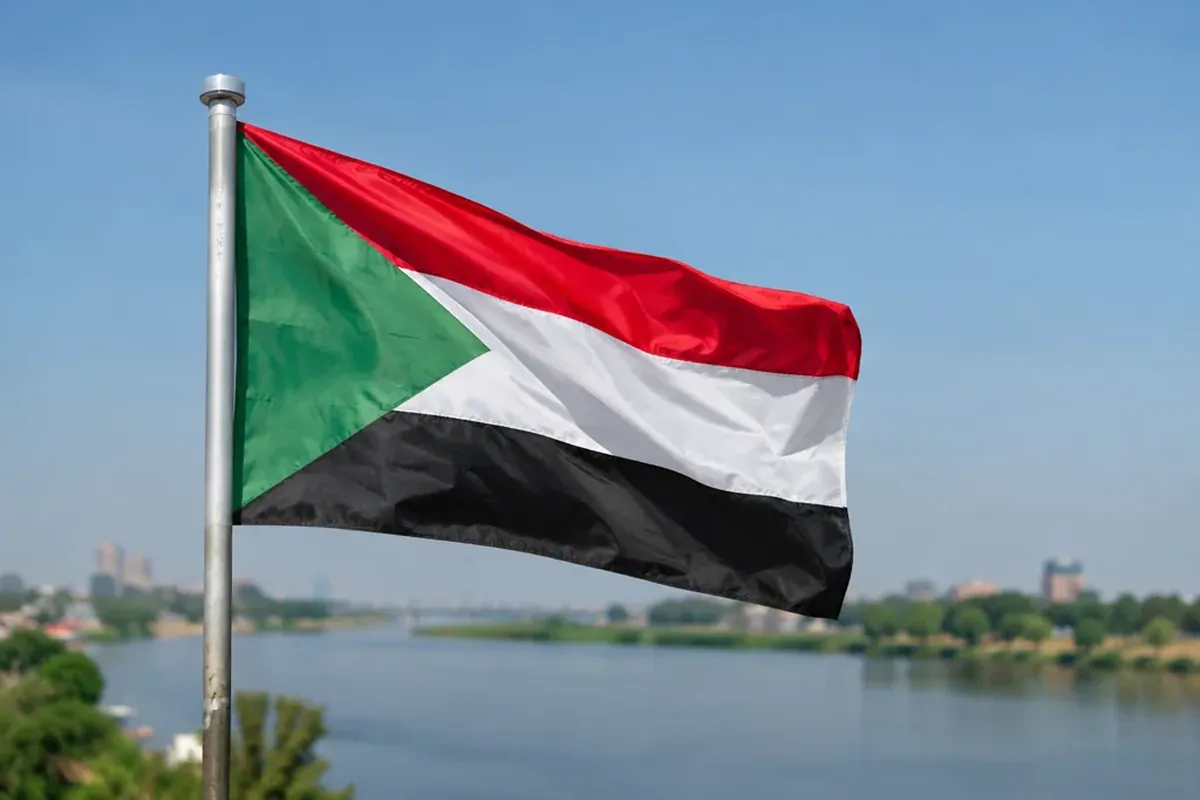
The flag of Sudan is a red, white, and black horizontal tricolor with a green triangle at the hoist. Officially adopted on May 20, 1970, it brings together the pan-Arab colors and symbols tied to Sudan’s own history: struggle, faith, the Mahdist Revolution, and agriculture. It replaced the country’s earlier blue, yellow, and green independence flag.
What the flag of Sudan symbolizes
Each of the four colors carries more than one association. Together, they connect Sudan’s national experience with a wider pan-Arab color tradition. Red, white, black, and green were first combined in the flag of the Arab Revolt in 1916; Sudan’s arrangement follows that tradition while giving the green triangle a prominent role.
| Color | Place on the flag | Meaning associated with Sudan |
|---|---|---|
| Red | Top horizontal stripe | The struggle and martyrs of Sudan and of the wider Arab nation; it is also associated with socialism and progress. |
| White | Middle horizontal stripe | Islam, peace, optimism, light, and love. It also recalls the White Flag League, a nationalist group that rebelled against colonial rule in 1924. |
| Black | Bottom horizontal stripe | Sudan itself and the Mahdist Revolution, whose symbolism included a black flag. |
| Green | Triangle at the hoist | Prosperity, goodness, and agriculture; green is also a symbol of Islam, the religion of most Sudanese people. |
The name Sudan derives from the Arabic phrase bilad as-sudan, meaning “land of the black people.” That connection helps explain why black is not merely a background color in the Sudanese flag: it refers directly to the country as well as to a historical movement.
How the national flag is arranged
The national flag has three equal horizontal stripes: red at the top, white in the middle, and black at the bottom. A solid green triangle begins at the hoist, or flagpole side. Its base fills the flag’s full vertical height, and its point reaches one-third of the way across the flag’s length.
Its official proportions are 1:2, meaning the length is twice the height. The official color specifications identify green as #007229, red as #D21034, black as #000000, and white as #FFFFFF. The design was created by Sudanese artist Abdel Rahman Ahmed Al-Jali.
At a glance, the red-white-black stripes resemble the Arab Liberation Flag used after Egypt’s 1952 revolution. Sudan’s green triangle is what makes the design distinct within that family. Unlike some related flags, it contains no star or lettering.
Sudan’s first flag looked very different
Sudan gained independence on January 1, 1956. On that day, the British and Egyptian flags were lowered and a new Sudanese flag was raised. The first national flag used three horizontal stripes of blue, yellow, and green, designed by the poet Macki Sufi.
Those colors were chosen with a different visual language from the present flag:
- Blue represented the Nile.
- Yellow represented the Sahara Desert.
- Green represented agricultural land.
The palette was deliberately neutral among the country’s different ethnic groups and political parties. It remained in use from 1956 until 1970. After Gaafar Nimeiry’s 1969 military coup, the independence flag was abandoned, and the current design was officially adopted on May 20, 1970.
The earlier blue-yellow-green flag later reappeared during Sudanese protests in 2018–2019.
Flags before Sudan became independent
During the Mahdist uprising of 1881–1899, Mahdist forces used black, red, and green flags. Muhammad Ahmad, the self-proclaimed Mahdi, gave a black flag to Abdallahi ibn Muhammad in 1881 as a symbol of the movement. The black stripe on the current flag is associated with this Mahdist history.
From 1899 to 1956, under the Anglo-Egyptian Condominium, Sudan had no separate national flag. British and Egyptian flags were flown together. A 1924 revolt used a white flag bearing the Egyptian flag in its canton and a map of the White Nile, Blue Nile, and Atbara River.
In April 1955, at the Afro-Asian Conference in Bandung, Sudan was represented by a white flag with the word “SUDAN” in red. The 1956 design became the first national flag of an independent Sudan.
Sudan and South Sudan have different flags
Sudan and South Sudan are separate countries with distinct national flags. South Sudan’s flag was first adopted by the SPLM in 2005 and became the national flag on July 9, 2011, the day South Sudan became independent.
| Feature | Sudan | South Sudan |
|---|---|---|
| Hoist-side shape | Green triangle | Sky-blue triangle |
| Main stripes | Red, white, black | Black, red, green, separated by white stripes |
| Star | None | Yellow five-pointed star in the triangle |
| Color tradition | Pan-Arab | Pan-African, with a structure closer to Kenya’s flag |
Both flags use black, white, red, and green, but those shared colors do not mean the same thing. In the flag of South Sudan, black represents its people rather than the Mahdists. Its yellow star represents national unity, while Sudan’s green triangle has no corresponding star.
Where Sudan is located and who its people are
Sudan is a sovereign country in Northeast Africa. It borders Egypt to the north; the Red Sea to the east; Eritrea and Ethiopia to the southeast; South Sudan to the south; the Central African Republic and Chad to the west; and Libya to the northwest. Khartoum is its capital and largest city.
With an area of 1,861,484 square kilometers, Sudan is Africa’s third-largest country. Its population was estimated at about 50.5 million in 2024. Before the secession of South Sudan in 2011, Sudan had been the largest country in Africa by area and the largest in the Arab League.
About 70 percent of the population is described as Sudanese Arab, while the country has more than 500 ethnic groups and more than 400 languages. Major non-Arab groups include the Beja, Nuba, Fur, Nubians, and Zaghawa. About 97 percent of the population after South Sudan’s independence is Sunni Muslim.
Common misunderstandings about the Sudanese flag
“The current flag was Sudan’s first flag.”
No. The first flag of independent Sudan was the blue-yellow-green tricolor raised in 1956. The present red-white-black flag with a green triangle replaced it in 1970.
“The green triangle represents South Sudan.”
No. Sudan’s green triangle is associated with prosperity, goodness, agriculture, and Islam. South Sudan has a separate flag with a sky-blue triangle and a yellow star.
“All red, white, black, and green flags have the same meaning.”
No. These are pan-Arab colors, but national meanings differ. Sudan links black to the country and the Mahdist Revolution; South Sudan uses black to represent its people.
“Sudan and South Sudan are the same country.”
No. Sudan is a sovereign state in Northeast Africa, and South Sudan became independent on July 9, 2011. Their separate flags make the distinction visible.
Frequently Asked Questions
What are the colors of the Sudan flag?
The flag has red, white, and black horizontal stripes plus a green triangle on the flagpole side.
What does the flag of Sudan symbolize?
It combines pan-Arab colors with Sudanese meanings: red for struggle and martyrs, white for Islam and peace, black for Sudan and the Mahdist Revolution, and green for agriculture, prosperity, and Islam.
Is Sudan a country?
Yes. Sudan is a sovereign country in Northeast Africa, with Khartoum as its capital and largest city.
What are the main ethnic groups in Sudan?
About 70 percent of the population is described as Sudanese Arab. Major non-Arab groups include the Beja, Nuba, Fur, Nubians, and Zaghawa, within a country of more than 500 ethnic groups.
Do Sudan and South Sudan have different flags?
Yes. Sudan uses a green triangle with red, white, and black stripes; South Sudan uses a sky-blue triangle with a yellow star and black, red, green, and white stripes.
How has Sudan’s flag changed over time?
Independent Sudan first used a blue-yellow-green tricolor from 1956 to 1970. The current flag replaced it on May 20, 1970.